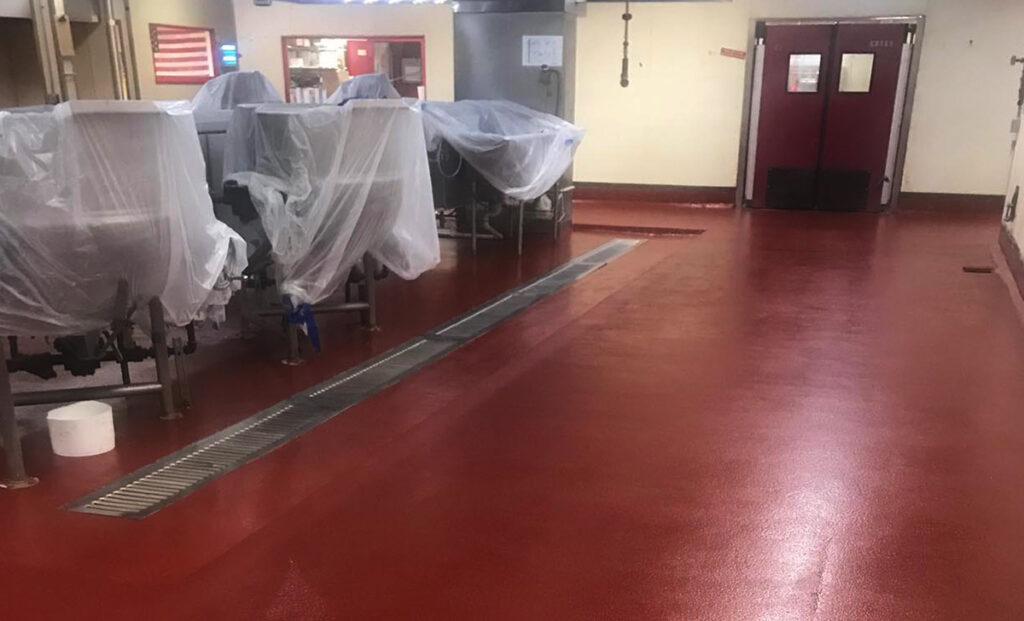
For food processing facilities in Western Massachusetts—from the dairies of the Pioneer Valley to the commercial bakeries in Springfield—the words “USDA Inspection” can trigger significant stress. When an inspector walks your floor, they aren’t just looking for cleanliness; they are looking for hygienic integrity. In a high-moisture, high-acid environment, your floor is either your greatest asset or your biggest compliance liability. Here is how to ensure your flooring passes the test every time.
1. The “Zero Tolerance” for Cracks and Spalling the USDA’s primary concern is the harborage of pathogens like Listeria and Salmonella. Standard epoxy floors often fail because they are brittle. When the concrete slab moves or undergoes thermal shock during a hot-water wash-down, the epoxy cracks. Those tiny fissures are impossible to sanitize and are an immediate red flag for inspectors. The Solution: Use Urethane Cement. Unlike standard epoxy, urethane cement expands and contracts at a rate similar to the concrete substrate. It is “thermal shock resistant,” meaning it won’t crack when you hit it with 180°F water, keeping your surface monolithic and compliant.
2. Eliminate the 90-Degree Corner (Integral Cove Base) If your floor meets your wall at a sharp 90-degree angle, you are likely harboring bacteria that a mop or pressure washer cannot reach. Inspectors specifically check these transitions for organic buildup. The Solution: An Integral Cove Base. We install a 4-inch or 6-inch radius cove that turns the floor up the wall in one seamless piece. By creating a smooth “U-shape” transition, we eliminate the corner entirely, making it easy to wash down and impossible for bacteria to hide.
3. Manage the Pitch (No Standing Water)”Birdbaths” or standing water on a production floor are one of the most common reasons for a failed inspection. Standing water indicates poor drainage and creates a slip-and-fall hazard, as well as a breeding ground for microbes. The Solution: Technical sloping. Before the topcoat is applied, LionStone utilizes Poly-Crete WR to build up low spots and ensure a positive pitch toward your drains. We water-test the pitch to confirm that no pooling occurs, satisfying both USDA and OSHA requirements.
4. Non-Porous Surfaces and Chemical Resistance Harsh sanitizers and organic acids (like lactic acid in dairies or citric acid in beverage plants) eat away at unprotected concrete and low-quality coatings. Once a floor becomes porous, it can no longer be truly “sanitized.” The Solution: High-performance topcoats. We specify systems that are 100% non-porous and tested for high-concentration chemical resistance. This ensures the floor remains “impermeable,” as required by USDA standards. The LionStone Advantage: Licensed Oversighting Western MA, many “floor guys” don’t understand the regulatory pressures of Division 09 construction.
As a Licensed MA Construction Supervisor (Unrestricted), Glenn Jobson approaches every food-grade project with a compliance-first mindset. We provide the technical data sheets, VOC compliance certificates, and antimicrobial test results you need to hand to an inspector with confidence. Don’t leave your next inspection to chance. Contact LionStone Concrete Coatings today for a “Flooring Compliance Audit” and ensure your facility stays in production.
Serving Springfield, Worcester, Pittsfield, and the surrounding New England region.